
Vjosa National Park Albania: Holidays & Hiking
The Vjosa in Albania is the last major wild river in Europe outside of Russia. It and its tributaries flow freely – along the entire stretch from its source in the mountains of Greece to its mouth in the Albanian Adriatic. It is a wilderness area with a fantastic mosaic of different habitats: narrow gorges in the upper section, wide gravel plains and sandbanks in the middle and a largely natural delta on the Adriatic coast. In the middle course alone, there are at least eight habitat types that are classified as the highest conservation priority in the EU.

In its catchment area, the village communities find fertile soil for farming and grazing. The abundance and diversity of fish fauna is of central importance to the local fishermen, who live in the lower reaches of the Vjosa in particular. Ecotourism is a growing economic sector on the Vjosa and its tributaries and in recent years activities such as rafting, canoeing, kayaking, swimming etc. have become established.
The Vjosa is particularly wild in nature. The crystal-clear stream meanders through the south of Albania between light-coloured sand and gravel banks. The water flows apart and back together again in branching arms, forming countless small islands. Lined by gentle hills, the riverbed is wider than ten football pitches in some places. It is one of the most important rivers in Albania, with a total length of 272 kilometres, of which the first 80 kilometres are in Greece and the remaining 192 kilometres in Albania.
Table of Contents
It rises in Greece in the Pindus Mountains, flows into Albania near Çarshovë and flows in a north-westerly direction through the towns of Përmet, Këlcyrë, Tepelenë, Memaliaj, Selenicë and Novoselë. It flows into the Adriatic Sea north-west of Vlorë.

The other tributary of the Vjosa is the Shushica with a catchment area of around 715 km2. A characteristic feature of the Vjosa’s catchment area is the presence of deep karst, which provides an abundant underground supply during the dry season.
Chemical analyses of samples from the Vjoša show that the water quality is generally good. Some high values were found for iron or hardness in the Vjosa and for chlorine in the Langarica. This river has the best water quality in the country and is suitable for all uses. Measured by the biotic index, the water quality is good, with the exception of two places: near a mine and at a bitumen and oil reservoir.

Until it emerges into the coastal plain north of Vlora, the Vjosa runs in a beautiful valley, partly surrounded by high mountains. In the southern part after the Greek border lies the region of Përmet – a secluded area around the small town with cultural monuments, high mountain peaks and a national park. To the east of Tepelena, the river passes through the deep Këlcyra Gorge. Further downstream, the human influence becomes greater: but despite the small towns and the important north-south axis, nature is still largely intact.
Tepelena is one of these small towns. 300 years ago, it was the most important town in the region. This is where the Vjosa picks up the Drino River, which flows down from Gjirokaster. The road to central Albania continues downstream, partly following the Vjosa in the valley and partly winding through the hills, where we come across the ancient town of Byllis in Mallakastra high above the river – certainly one of the most beautiful historical sites in Albania.

Europe’s last wild river becomes a national park
For years, the entire river basin has been threatened by dam projects. Their construction would destroy these natural habitats, flood large parts of the valley and dry up other sections. There are plans for 40 hydropower plants in the Vjosa catchment area: 9 on the Vjosa itself and 31 on its tributaries. Three tributaries – Lengarica, Shtika and Çarshova – are already affected by dams and therefore cannot be included in a future national park.
The biggest threat that the Vjosa has been facing for more than two decades is hydropower plants. But the lower reaches of the Vjosa are also under threat. The Albanian government wants to build an airport in a protected area near its mouth in the Adriatic and tourist facilities near the Narta Lagoon. The proposal for the new demarcation of protected areas in Albania envisages excluding those areas from the Narta protected area that could be used for the airport and hotel facilities.
In September 2020, Albania’s Prime Minister Edi Rama announced his intention to establish a Vjosa National Park. However, the plans of the Albanian protected area authority only provide for minimal protection for the Vjosa. This would not exclude hydropower plants and would fall far short of the protection standards of a national park. Some politicians want to leave the door open for construction projects – a major threat to the Vjosa.
In April 2021, the energy company Shell began exploring for oil and gas along the banks of the Vjosa in the Permet area. Without the protection that a national park would offer, Shell will be allowed to start drilling, which would have catastrophic consequences for the Vjosa valley. Local residents are already fighting back and protesting.
Although there are still many threats, in June 2022, the Albanian government took a first step towards officially protecting the Vjosa and its tributariesby signing a declaration of intent with our partner Patagonia, committing to establish a Vjosa Wild River National Park.
Tepelene
The small town is the centre of the middle Vjosa valley. The road forks here: southwards to Gjirokaster, a fork leads further along the Vjosa eastwards to Përmet. Tepelena is known for its mineral water, the castle and Ali Pasha (1741-1822). The despot from a neighbouring village controlled southern Albania and north-western Greece and was beheaded by the Turks when he became too powerful for them. A monument commemorating him can be found at the southern entrance to the village.

Ali Paşa Tepelenë, alias the Lion of Janina, became Pasha or provincial governor of Janina through murder and intrigue from 1788. He extended his capricious rule within the Ottoman Empire to large parts of Albania and Macedonia, Epirus, Thessaly and the Morea.
His father Veli, the Bey of Tepelenë, died a poor man when Ali was 14 years old. His mother, Khamco, founded a band of robbers to restore the family’s political and material fortunes, and Ali became a notorious robber leader. His son Veli took over Trikkala and later the Morea, while another son, Mukhtar, became Pasha of Lepanto. Although he was constantly thwarted by the Christian Souliots, whom he finally subdued in 1803, Ali gained control of the Gulf of Arta and conquered the harbours of Butrinto, Preveza and Vonitsa. He also gained control of the Pashaliks of Elbasan, Delvino, Berat and Valona (Vlore).

Throughout this time, he increased his wealth through murder and blackmail and extended his power over Beys and communities through intrigues with Greeks and Albanians. Although he was appointed viceroy of Rumelia, he repeatedly failed to carry out the orders of the Ottoman sultan. In fact, he acted as an independent ruler and was treated as such by the British and French, with whom he schemed and hoped to establish Janina as a naval power. In 1819, the Sultan Mahmud II, who wanted to centralise the government of his empire, was determined to remove Ali and authorised his assassination. Ali tried to save himself with his old methods of murder, intrigue and blackmail, but was eventually gunned down, abandoned by his sons and allies.

Rent a car! Albania is very safe for motorists, & you can drive across the entire country in less than 6 hours! Best of all, rental cars are very cheap (starting at €30) & easy to book by comparing rates across dealerships in Tirana and Saranda using DiscoverCars.
Compare Rental DealsKelcyra
Just west of Këlcyra, the Vjosa passes through a deep gorge, the Gryka e Këlcyrës. A castle was built to control this passage in the 13th century at the latest. The Turks extended the castle and also built a seraglio in Këlcyra in the 19th century. At this time, Këlcyra experienced its heyday as a central trading centre between Berat, Korça and Gjirokaster. In the castle, which towers high above the town, there are also remains of walls from antiquity; the Illyrians already made their home in the castle. Even older are some tombs dating back to the Bronze Age. Later, the Romans used the route through the Këlcyra gorge and built a small settlement. A medieval chronicle from 1272 mentions the place with the Latin name Clausura. There are several centuries-old Orthodox churches around Këlcyra.
Discover My Tour Offers


Përmet
The town of Përmet is nestled in the picturesque Vjosë river valley in south-east Albania. This town of just over 10,000 inhabitants is an absolute must for culture vultures travelling through Albania. It also has plenty to offer foodies and adventure seekers.
The greenest and cleanest city in Albania, also known as the ‘City of Roses’. The small town of Permet is famous for its folk music and the well-known clarinettist Laver Bariu, for literary personalities and for its good cuisine, especially for its desserts, known as ‘gliko’, or preserves. Good wine and raki are served in Permet and the surrounding area.

At the beginning of its history, Përmet was called Tryfilia. The current name comes from a legendary Albanian hero called Premt. According to stories passed down from generation to generation, Premt preferred to take his own life rather than lose it at the hands of an enemy he was facing.
In the 15th century, Përmet came under Ottoman rule after the Ottomans conquered Albania at the end of the 14th century. In the following centuries, the Ottomans endeavoured to convert the country to Islam through political measures, trade networks and tax incentives. However, the Christian areas of the country, including Përmet, resisted conversion. Later, in the 20th century, the city played an important role in the First Balkan War, the Greek-Italian War and the Second World War. During the subsequent communist era, Përmet became known as the ‘hero city’.
Tip: In Permet, you should climb a large rock located very close to the city centre, from where you can overlook the city and the Vjosa River, the city’s viewpoint, so to speak. Ask for directions, the place is south of Permet. The hot spring is located in a scenic setting.
Activities in Permet
Katiu Bridge
This stone bridge, located about 8 kilometres from Përmet, was built by the Ottomans in the 19th century and is also known as the Ottoman Ali Pasha Bridge, after the famous Albanian leader who commissioned it.

This beautiful relic of the Ottoman Empire spans the beautiful Lengarica River in the Fir National Park of Hotova. It is rather small for an Ottoman bridge and consists of a large arch spanning the Lengarica Gorge. But even though it’s small, that doesn’t mean it’s not spectacular.
Benja Thermal baths
In the shadow of the Katiu Bridge is another popular attraction in the Lengarica Gorge: the famous Benja thermal baths. These unique, natural baths are fed by the Lengarica River and are said to have a special therapeutic effect. There are three baths in total, each designed to heal a different part of your body!
Vjosa: The last wild river in Europe: Vjosa near Permet © Adventure Albania
Leusa

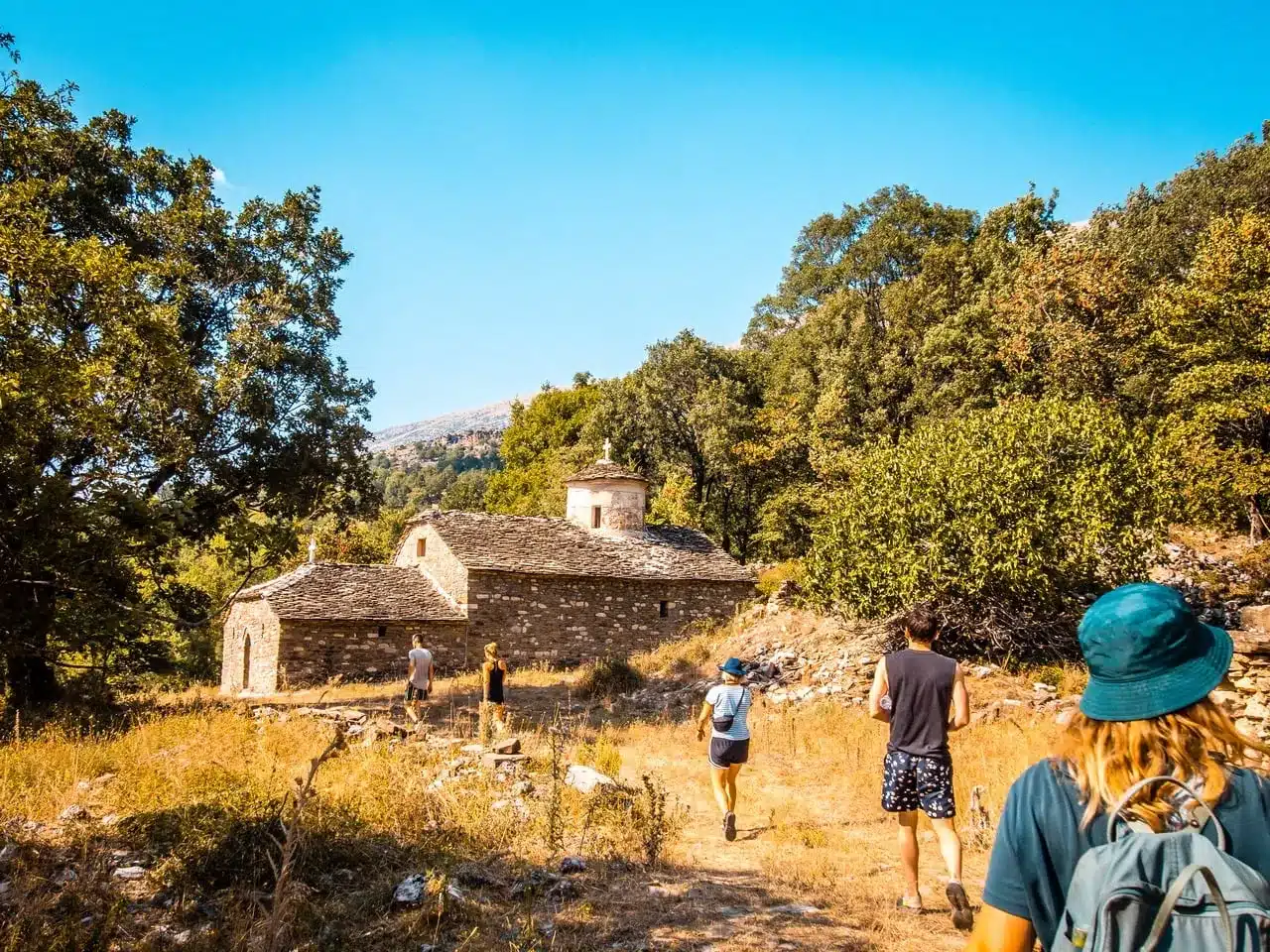
The Church of St Mary of Leusa is one of the most important religious monuments in Permet. The church was once one of the largest monasteries and schools built in the late 18th century. A dense forest surrounds the church, but its interior hides a treasure. The interior of the church is covered with ornate paintings and Orthodox icons. Many of these religious artefacts are relatively old and open to the public. The church is located two kilometres from the town and can only be reached on foot or by off-road vehicle. Nevertheless, it is an excellent destination for people who love both nature and culture.
Useful information
- To get to Leusa, you will need a 4×4 vehicle or a similar vehicle. It is recommended to walk.
- The walk to Leusa takes 30 to 40 minutes. Try to go early in the morning or in the evening.
- To enter the church and see the icons, you will need a key. To get it, you need to ask the priest who lives in the first house near the church (the house on the right side of the road).
- There is a spring near the entrance to the village. The water is fresh and cold.

How to get there
By car – The Vjosa Valley lies on the north-south axis from central Albania via Fier to Gjirokaster and the Greek border. The road used to lead through the hills of Mallakastra (via Ballsh) in tight bends, on a poor tarmac strip and with lots of ups and downs. Since 2012, a good section has been a dual carriageway via Levan and through the lower Vjosa Valley – only 23 kilometres from the border between Qark Fier and Qark Gjirokaster still run on the old, but upgraded road. This new route is still missing on many maps.
Coming from the north, take the Fier bypass in the direction of Vlora and leave the motorway at the village of Levan. Coming from the south from Greece, you can either take the Kakavia border crossing north-west of Ioannina and drive on a good motorway via Gjirokaster to Tepelena. Alternatively, there is the small border crossing ‘Tre Urat’ to the west of Konitsa. The 35 kilometres from there to Përmet are generally quite easy to drive despite the narrow road – but some kilometres wind through the hills.
The connection from Berat to Këlcyra (between Tepelena and Përmet) is extremely poor. The route is mostly unpaved, has hardly been repaired since the last world war and is far too well marked on many maps. Only recommended for off-road vehicles in dry conditions. The connection from Çorovoda is even worse.
Buses – There are regular buses from Tirana to Përmet. For Tepelena you have to take a bus to Përmet or Gjirokaster/Saranda. The departure point is at the large bus terminal on the western outskirts of Tirana. In the late afternoon there are probably no more buses travelling this far.
From Saranda, the buses to Tirana pass through Tepelena. There are connections to Përmet from Gjirokaster and Tepelena as well as Korça.
There are also buses from the border crossing ‘Tre Urat’ (rare) to Përmet and from Greece directly to Përmet and Tepelena.
Rafting & Kayaking in Albania
Immerse yourself in the spectacular natural landscape of Europe’s last wild river on a 3-hour whitewater rafting tour in Permet. Or experience the Vjosa River on a multi-day kayak tour.

Accommodation & Food
If you are looking for a traditional experience in a quiet setting, then the “Tradicional Guest House Permet” is a good choice. When you arrive, you will have the most beautiful view of the valley and the countryside.

The accommodation is not located in Permet, but 6 km from the city centre. It is closer to the Benje hot springs than to the town of Permet, so it is perfect if you want to stay in nature. The owners will tell you all about the history of this magical old building over rakia and homemade wine. The road leading there is not easy to find, but once you arrive, it’s worth the drive. If you can, it’s best to arrive during the day.
☑ Check prices and availability here.

For you stay directly in Permet, I recommend Hotel Kaso Ervehe. The family run business in an old stone villa is centrally located just a few metres from the main square. Konstantinos and his father have proven to be great hosts. I enjoyed the peaceful atmosphere, the cozy rooms and the great breakfast. ☑ Check prices and availability here.
Throughout the Vjosa Valley, there are always restaurants by the roadside. Some of them also offer rooms. It is advisable to spend the night in Përmet or a little further away, for example in Gjirokaster. There are hotels in Përmet directly on the main square and smaller hotels and guesthouses just outside the town centre.
The Përmet region is the centre of the slow food movement in Albania – although almost everywhere in Albania there are almost exclusively local products, here they are marketed with the international label. We recommend the ‘Antigonea’ restaurant right next to the main square on the road that leads between the hotels down to the river.
Culture & Hiking
The small town of Përmet has a rich cultural programme. Events are regularly organised in the local cultural centre. At weekends, the main square is also a hive of activity in the evening – but there is no real nightlife here.
The area is well suited for hiking and other outdoor activities such as mountain biking, swimming in the Vjosa, etc., even outside the national park. Very ambitious mountaineers can climb the mountain range above the town from Përmet via Leusa: It is around 1250 metres up to the pass and almost 600 metres up to the summit of Dhëmbel (2050 m). The Nemërçka is not approached from the east.
As a wild river, the Vjosa can be travelled by experienced paddlers. Rafting tours are offered from Përmet.
Weather
The climate in southern Albania is usually quite mild or hot in summer. However, it is important to bear in mind that the Vjosa Valley is surrounded by very high mountains to the south. Even if the valley floor is below 300 metres, it can still get quite chilly in winter. And on the route to Korça in particular, you soon reach areas that are regularly covered in snow.
Onward journey
Car – Most of the secondary roads are in a poor condition – a playground for 4×4 drivers, although it is to be expected that landslides or wet conditions will make the tracks impassable or that nature will have reclaimed the road. However, new village access roads are asphalted from time to time.
The journey from Përmet via Leskovik and Erseka to Korça is very beautiful. However, it takes at least three and a half hours, as it is a narrow road through the mountains – for long stretches, the little road runs at 1000 metres and higher, with potholes in the asphalt surface. At Çarshova you should continue southwards and take the southern road via the ‘Tre Urat’ border crossing to Leskovik.
The direct connection from the ‘Tre Urat’ border crossing to Leskovik is fresh and well developed. Leskovik is very depopulated – an old church, a small mosque on the hill at the very western end of the main road and the village square with a plane tree are noteworthy. Around ten kilometres after Leskovik there is a pretty restaurant with a fish farm and overnight accommodation: ‘Farma Sotira’. Horse riding and hiking tours are also offered there. In Borova, just before Erseka, a large cemetery commemorates the victims of a Wehrmacht crime.
Buses & shared taxis – There are buses from Përmet to Tirana (morning, noon), to the border or to Greece, to Korça and Gjirokaster. The surrounding villages can be reached by furgon from the local centres (Përmet, Këlcyra, Tepelena, Ballsh). In Tepelena, the buses and shared taxis travelling through stop on the main road at the Ali Pasha monument.
In Përmet, the minibuses to the villages stop in the street just south of the main square. Some of the buses to more distant destinations start on the other side of the riverbank.
Recommended


Hi. I’m Dirk, adventure traveller, originally from Germany. In 2020, Adventure Albania, started as an Albania travel blog. A few months later, I founded a small travel agency to complement my recommendations with some of the best experiences that I found, organized by local partners and friends.
I have meanwhile moved to Albania and am now based in Tirana. I continue exploring new corners of Albania and the balkans and regularly update my blog with the latest in travel and experiences. If you are visiting Albania as a digital Nomad, check out my coliving project "Nomad Island Tirana".

I only make genuine, worthwhile recommendations based on my experience, expertise, & research. If you buy through my links, I may get a commission, supporting this website at no extra cost to you.
 English
  Français
  Italiano
  Polski
  Nederlands
  Svenska
  Español
  עִבְרִית